Quasi-Direct Drive Based Force Estimation in Hip Exoskeleton Systems

In the field of human-robot interaction, a recent research project focuses on improving force estimation and control in exoskeleton systems for rehabilitation and assisted locomotion.
The study proposes a quasi-direct drive (QDD)-based approach that enables interaction force estimation without using additional force sensors. Instead of relying on external sensing hardware, the method leverages the intrinsic dynamics of the actuator to estimate torque and interaction forces from motor current and motion data.
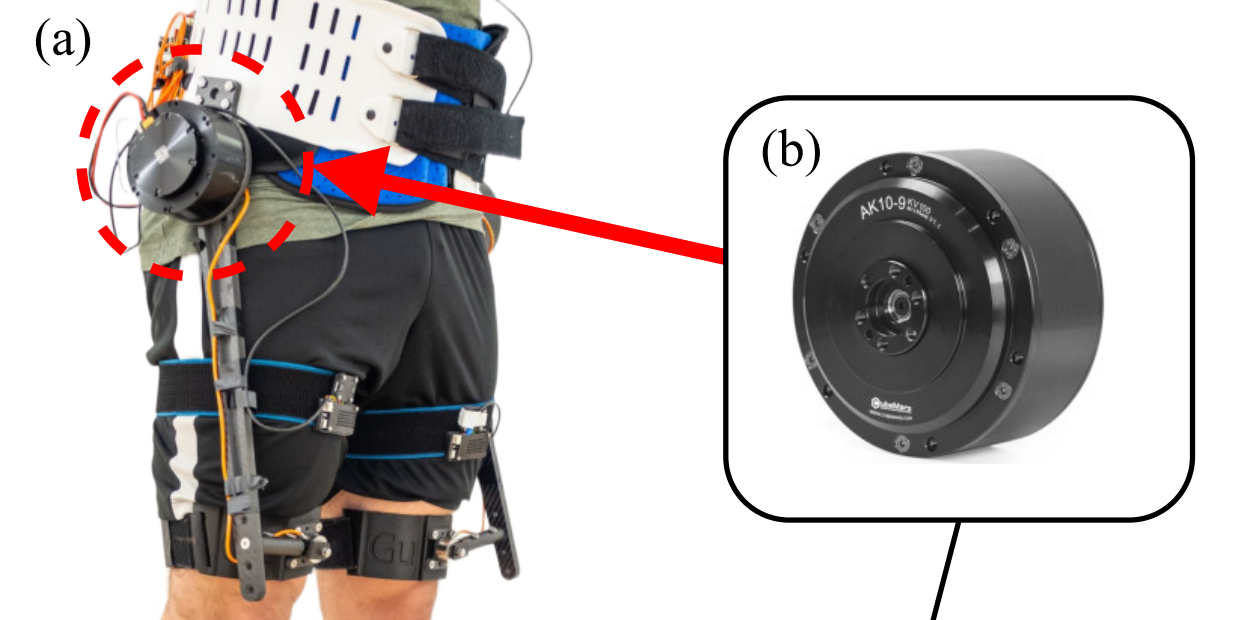
A hip exoskeleton was developed using the CubeMars AK10-9 V1.1 robotic actuator. The system adopts a low-reduction-ratio architecture to improve backdrivability and ensure natural human motion. A detailed dynamic model was established, incorporating inertia, friction, and transmission characteristics to enable real-time torque estimation.
Experimental validation was conducted through treadmill walking tests with different assistive torque levels. The results show that the proposed method achieves a mean absolute error of 2.78±0.58 N (6.4% of rated force), while also improving torque tracking performance by 23% compared to conventional control methods.
Overall, the project demonstrates a sensorless force estimation framework for exoskeletons, reducing system complexity while improving control accuracy and human-robot interaction performance.
Learn more: https://www.cubemars.com/human-exoskeleton-interaction-force-estimation-based-on-qdd.html