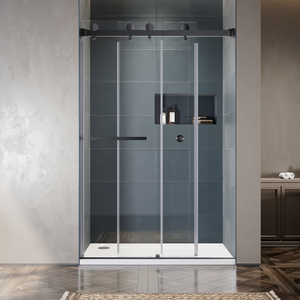
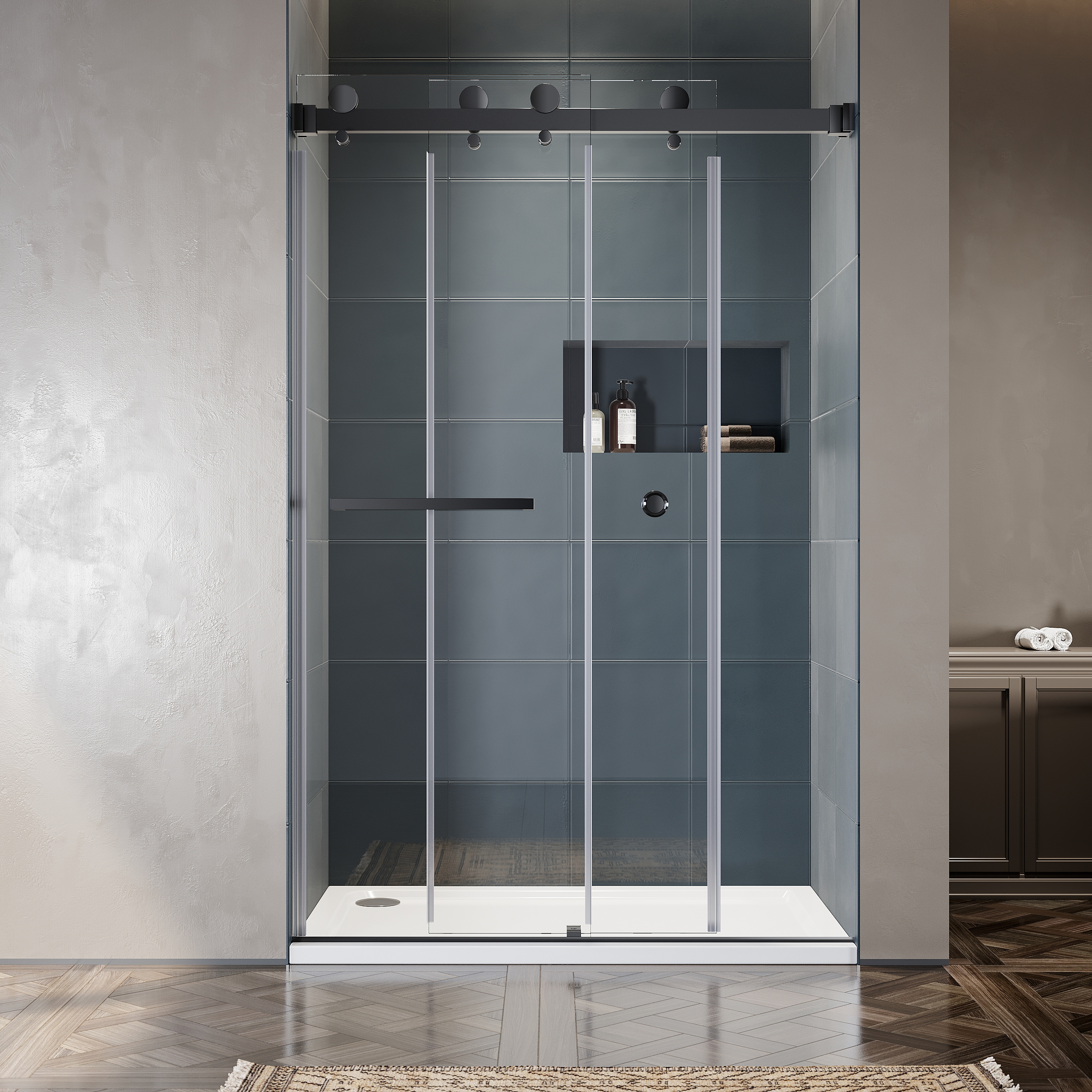
Why Frameless Shower Doors Are the Best Choice for Your Bathroom — A Specification Guide

The bathroom renovation is almost finished. The tile is grouted. The vanity is in. The fixtures match. And then the shower door goes up — and either completes everything you built, or contradicts it.
This is the moment when the frameless shower door earns its specification. Not because it costs more (at factory-direct pricing, the gap is often under $100). Because it is the only configuration that lets the renovation speak for itself — without a frame dividing it, a track interrupting it, or a visual border announcing where the design choices stopped.
Here's the complete case for frameless glass, built on specification rather than aesthetics.
What "Frameless" Actually Means
A framed shower door has aluminum channel running along the perimeter of every glass panel — top, bottom, and both sides. The glass sits inside the frame. The frame carries a portion of the structural load, which is why framed doors can use thinner glass.
A frameless shower door has no perimeter frame. The glass mounts directly to the wall via hardware — hinges for swing doors, rollers for sliding doors — and the glass itself carries the full structural load. This is why frameless doors require thicker glass: 3/8-inch (10mm) tempered glass, versus the 1/4-inch (6mm) common in framed configurations.
Removing the frame requires better glass, better hardware, and better installation — while delivering better aesthetics, better maintenance, and a better long-term result.
Reason 1: The Glass Specification Changes Everything
At a 30-inch panel width, 10mm glass deflects approximately 55–60% less than 6mm glass under equivalent lateral load. That's the distinction between a panel that feels structural when you push it — and one that gives slightly, communicating its own limitations every time you touch it.
Every Unikoo frameless door — UKS04, UKD01, UKH07, and all custom configurations — uses 3/8-inch SGCC and ANSI Z97.1 certified tempered glass as the baseline. Not a premium option. The standard.
SGCC certification means an independent laboratory tested the glass and confirmed it meets the US national safety glazing standard. When the glass breaks, it fractures into small blunt pieces rather than sharp shards.
Reason 2: Maintenance Becomes a Choice, Not an Obligation
The framed door's maintenance problem is structural. The aluminum channel creates a geometry that water flows into but doesn't flow out of. Soap residue, mineral deposits, and mildew accumulate in the channel interior — a surface a standard cloth can't reach.
The frameless door removes the channel entirely. With EnduroShield coating — factory-applied to both sides of every Unikoo frameless panel — even the glass surface is fundamentally different.
EnduroShield fills microscopic surface pores, raises the water contact angle to 100°+, and prevents soap film and mineral deposits from bonding to the glass. Water beads and runs off.
Practical result:
Weekly maintenance: 15–20 minutes → 3–5 minutes
Annual deep cleaning: eliminated
Over 10 years: estimated 180–200 hours saved
The coating is included in the base price. Not an upgrade. Standard.
Reason 3: The Visual Effect Is Structural, Not Decorative
A framed door creates a visual boundary — an aluminum border that terminates the sightline at the door surface. The eye stops at the frame.
A frameless door removes that boundary. Clear 3/8-inch glass transmits approximately 88–91% of visible light. The tile behind the panel, the depth of the shower enclosure, the back wall — all visible from the bathroom entrance. The eye reads the full depth of the room as a single continuous space.
In small bathrooms — the 5×7 layouts that make up the majority of American primary bathrooms — this visual continuity is the single most effective way to make the space feel more open without moving any walls.
Reason 4: The Hardware Determines the Decade
Most retail shower doors use zinc alloy hardware with chrome plating. On installation day, zinc alloy with chrome plating is visually indistinguishable from stainless steel. Around year three, the plating wears at high-contact points. Once the plating breaks through, the base metal corrodes visibly.
Unikoo's frameless doors use:
316 stainless steel — primary structural components (rollers, hinge brackets)
304 stainless steel — handles and secondary hardware
The molybdenum content in 316-grade stainless specifically resists chloride-based corrosion — the mechanism that chlorinated tap water and humid bathroom air accelerate continuously.
At factory-direct pricing, this hardware specification is the standard on every model in the line.
Reason 5: Factory-Direct Pricing Changed the Equation
The frameless shower door used to cost $900–$1,400 through showroom channels — four distribution layers, each adding 10–20% markup.
Factory-direct sourcing compresses that chain to one step. The savings translate directly to pricing:
Specification Big-Box Retail Unikoo Factory-Direct
Glass thickness 6mm (1/4") standard 10mm (3/8") standard
Glass certification Self-certified SGCC + ANSI Z97.1
Hardware grade Zinc alloy + plating 304 + 316 stainless
Coating None / optional EnduroShield — standard
Typical price $300–$700 $650–$900
Shipping $150–$500 Free nationwide
The framed-versus-frameless decision is no longer a budget decision. The performance difference costs $50–$100 more than a framed baseline — and buys a product that holds up for a decade rather than showing its compromises in year three.
The Specification That Delivers All Five
1)3/8-inch SGCC + ANSI Z97.1 certified tempered glass
2)304 + 316 stainless steel hardware
3)EnduroShield coating — both sides, factory-applied
4)Factory-direct pricing from $650
5)Free nationwide shipping
6)Zero sales tax in 48 states
7)Custom dimensions quoted in 2 business hours