What does hard water actually do to shower glass?

Hard water leaves mineral deposits on glass every time it evaporates. Water itself doesn't damage glass — water is chemically inert to glass under normal conditions. What damages the appearance and eventually the surface is what's dissolved in the water: calcium carbonate and magnesium carbonate, the minerals that define "hard" water.
Every time water sits on the glass surface and evaporates — which happens on every square inch of the shower enclosure after every use — it leaves behind the minerals that were dissolved in it. Soft water leaves a thin, mostly invisible residue. Hard water, with significantly higher mineral concentration, leaves a visible, accumulating film.
The first few weeks, this looks like light spotting — the classic "hard water spots" that show as a cloudy texture when the glass is viewed at an angle to a light source. Left unaddressed, the mineral film thickens with each subsequent evaporation cycle. After months without removal, the deposits build into a chalky, sometimes crystalline buildup that's no longer just a film — it's an accumulated mineral layer with measurable thickness.
How hard does water have to be before this becomes a real problem?
Water hardness is measured in grains per gallon (GPG) or parts per million (PPM) of dissolved calcium carbonate equivalent. The general classification:
Soft: 0–1 GPG (0–17 PPM)
Slightly hard: 1–3.5 GPG (17–60 PPM)
Moderately hard: 3.5–7 GPG (60–120 PPM)
Hard: 7–10.5 GPG (120–180 PPM)
Very hard: over 10.5 GPG (over 180 PPM)
Most municipal water in the US falls in the moderately hard to hard range, with significant regional variation — the upper Midwest, the Southwest, and parts of Texas and Florida frequently test in the hard to very hard range due to limestone and mineral-rich aquifers, while the Pacific Northwest and parts of the Northeast tend toward soft to moderately hard.
At moderately hard water and above, visible spotting on shower glass typically appears within two to four weeks of installation without any cleaning intervention. At very hard water levels, visible spotting can appear within days.
This isn't a defect in the glass or the water — it's the mineral content doing exactly what it does on every surface water touches and evaporates from. The practical question isn't whether hard water will leave deposits (it will, in any hard water area), but how the glass surface and the maintenance routine handle it.
Does hard water permanently damage glass, or is it just a cleaning issue?
Both, depending on how long the deposits are left untreated.
In the early stage — spotting and light film, addressed within weeks — the deposits sit on the glass surface and are removable with standard cleaning. The glass itself is unaffected; the mineral layer is a surface deposit, not a chemical change to the glass.
In the late stage — accumulated buildup left for months or years — the mineral deposits can etch the glass surface. This happens through a combination of mechanisms: the mineral crystals themselves create micro-abrasion during normal cleaning attempts (scrubbing crystallized deposits with anything other than the correct dissolving agent essentially sands the glass surface), and in some water chemistries, the sustained mineral contact combined with the slight acidity or alkalinity of the local water can produce surface etching that's permanent — a microscopically roughened glass surface that scatters light differently than smooth glass and that no amount of cleaning will fully restore.
This is the practical reason hard water spotting matters beyond appearance: spots that are cleaned within weeks are a maintenance routine. Spots left for years can become a permanent surface condition that affects the glass's clarity for the life of the door.
Does hard water affect the hardware the same way it affects the glass?
The mechanism is related but the outcome is different.
Mineral deposits accumulate on hardware surfaces the same way they accumulate on glass — wherever water sits and evaporates. On hardware, this typically shows as a chalky white buildup at the base of handles, in the crevices of decorative hardware details, and at the hinge or roller mechanism where water collects during use.
The more consequential interaction is with the hardware's moving parts. Mineral buildup in roller tracks, hinge pivots, and sliding mechanisms creates resistance — a door that operated smoothly on installation begins to feel gritty or requires more force to slide or swing as mineral deposits accumulate in the mechanism. This is a separate problem from the corrosion mechanism covered in hardware grade discussions — even 316 stainless steel hardware accumulates mineral deposits from hard water; the corrosion resistance of the metal doesn't prevent mineral buildup on its surface or in its moving mechanisms.
For sliding door rollers specifically, mineral buildup in the track is the most common cause of a door that becomes progressively harder to slide over the months after a clean installation — not a hardware defect, but an accumulated mineral condition that requires periodic track cleaning.
What actually prevents hard water spotting, versus just cleaning it after the fact?
Two different strategies address hard water differently, and understanding the difference matters for choosing the right approach.
Reactive: cleaning after deposits form. A squeegee used after every shower removes the water before it has a chance to evaporate and deposit minerals — this is the single most effective reactive strategy and the reason squeegee use is universally recommended for any shower glass in a hard water area. Weekly cleaning with a vinegar-based or commercial hard water remover dissolves deposits that did form despite squeegee use. This approach works but requires consistent daily and weekly effort — and consistency is the part that fails in practice. A squeegee that's used for the first month and then forgotten doesn't prevent the problem; it just delays it.
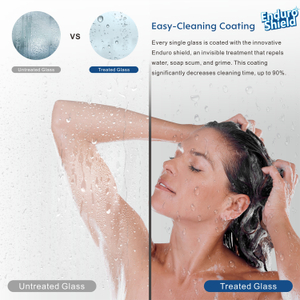
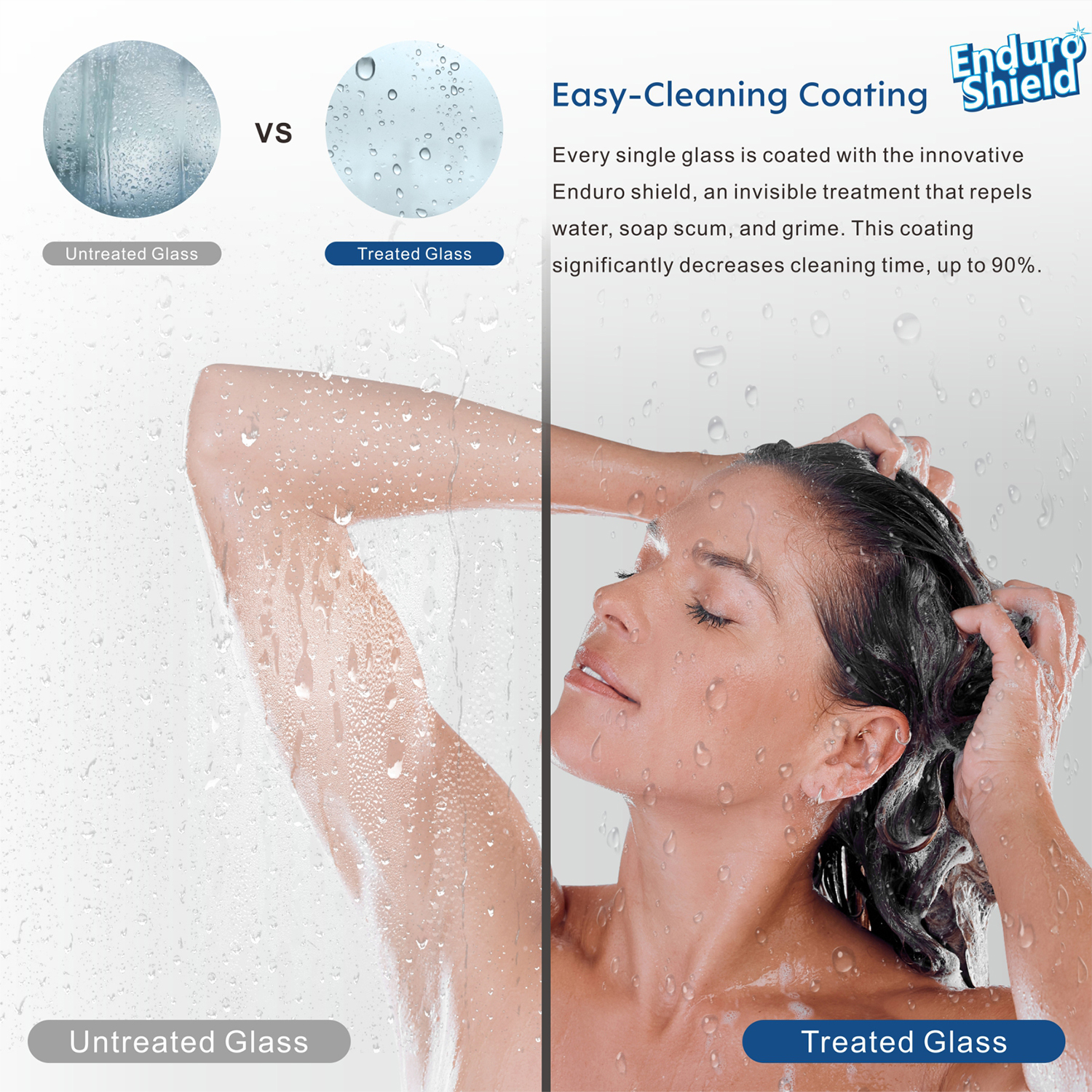
Proactive: hydrophobic glass coating. A factory-applied or professionally applied hydrophobic coating — such as EnduroShield — chemically bonds to the glass surface and changes how water interacts with it. Instead of water sheeting across the glass surface and sitting in a film as it evaporates, water on a hydrophobic-coated surface beads and rolls off, carrying mineral content with it before it has the chance to dry and deposit on the glass. This doesn't eliminate cleaning entirely, but it dramatically reduces both the frequency and the difficulty of the cleaning that's required — what would be a 15–20 minute scrub-down on uncoated glass in a hard water area becomes a 3–5 minute wipe-down on coated glass.
The mechanism is mechanical, not chemical removal: the coating doesn't dissolve minerals, it prevents water from sitting long enough to deposit them in the first place. This is why coated glass in hard water areas shows dramatically less spotting even with identical water chemistry and identical shower frequency to uncoated glass in the same household.
Does a water softener solve the problem instead of a glass coating?
A whole-house water softener addresses the mineral content at the source — reducing the calcium and magnesium concentration in all water used in the home, which reduces the mineral deposit rate on every surface, not just shower glass.
This is the more comprehensive solution if hard water is causing issues beyond the shower — scale buildup in pipes and water heaters, spotting on dishes, reduced soap lathering. The cost is significantly higher than a glass coating: whole-house softener systems typically run $1,500–$5,000 installed, versus $0 (factory-applied) to a few hundred dollars (aftermarket application) for a hydrophobic glass coating.
For a household specifically concerned about shower glass appearance and cleaning time, and not experiencing broader hard water issues elsewhere in the home, the glass coating addresses the specific problem at a fraction of the cost. For a household with hard water issues across multiple systems — water heater scale, appliance buildup, skin and hair effects — a whole-house softener addresses the source, and the glass coating becomes a secondary benefit rather than the primary solution.
These aren't mutually exclusive. A household with a water softener still benefits from a hydrophobic glass coating, because even softened water carries some residual mineral content and benefits from the bead-and-roll-off behavior that reduces any spotting to a minimum.
What should I specify when buying a shower door in a hard water area?
Confirm the coating is factory-applied, not an aftermarket add-on you'll need to apply yourself. A factory-applied hydrophobic coating is bonded under controlled conditions and typically more durable and even than a field-applied product. Unikoo's full frameless line includes EnduroShield on both sides of the glass as a standard specification — not an upgrade option — across UKS04, UKS13, UKH07, and all custom configurations.
Ask about coating durability and reapplication. Hydrophobic coatings degrade gradually with abrasive cleaning and time — typically maintaining strong performance for 2–5 years before the bead-and-roll-off effect noticeably diminishes. Aftermarket reapplication is available when this happens; ask the supplier whether reapplication products are available for the specific coating used.
Confirm both sides of the glass are coated, not just the exterior-facing side. Both surfaces of a shower glass panel are exposed to water during use — the interior surface during showering, both surfaces during cleaning and condensation. A coating applied to only one side leaves the other side fully exposed to hard water deposit accumulation.
If in a very hard water area, plan for a squeegee habit regardless of coating. Coating reduces the cleaning burden; it doesn't eliminate water exposure entirely. A 10-second squeegee pass after each shower, combined with factory-applied coating, produces the lowest-maintenance result achievable without a whole-house softener.
In very hard water regions — much of Arizona, Texas, the upper Midwest, and similar high-mineral-content areas — the combination of 10mm SGCC-certified glass with factory-applied EnduroShield on both sides and 316 stainless hardware (which resists corrosion independent of the mineral deposit issue) is the specification that performs correctly for the life of the door, rather than requiring early glass replacement or extensive aftermarket treatment to manage spotting that uncoated glass would show within weeks.